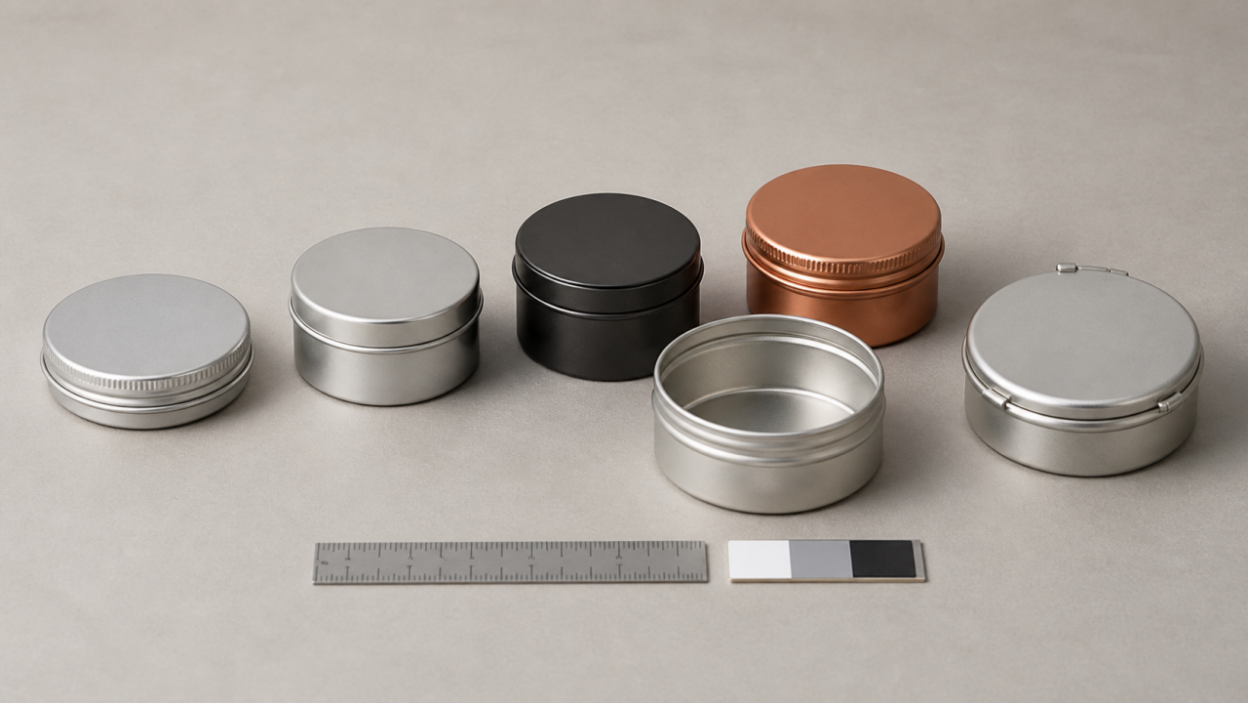
2 oz Tins With Lids: A Buyer’s Specification Guide

A 2 oz label sounds precise, but it does not tell a packaging buyer the usable internal diameter, fill height, closure displacement, headspace, product weight, or performance of the complete pack. Two tins sold under the same nominal capacity can hold different amounts of a balm, powder, tea, hardware set, candle, sample kit, or accessory.
This specification guide helps buyers turn the phrase 2 oz tins with lids into measurable requirements. It covers usable capacity, closure choice, product compatibility, small-format decoration, packing tests, and the information needed for a reliable wholesale quotation.
Treat 2 oz as a Starting Point, Not the Final Specification
Confirm whether 2 oz refers to fluid volume, net weight, a seller category, or a target fill. Ounces of weight and fluid ounces are not interchangeable, and product density changes the amount that fits. The closing lid, thread or curl, liner, insert, and required headspace can further reduce usable space.
Provide the actual product and target fill for testing. Record internal diameter at the narrowest usable point, usable depth with the selected lid, overflow capacity where relevant, target fill line, headspace, and filled weight. Use the small metal tins buyer guide [Internal Link] for the broader size-selection context.
Choose the Lid by Use and Opening Behavior
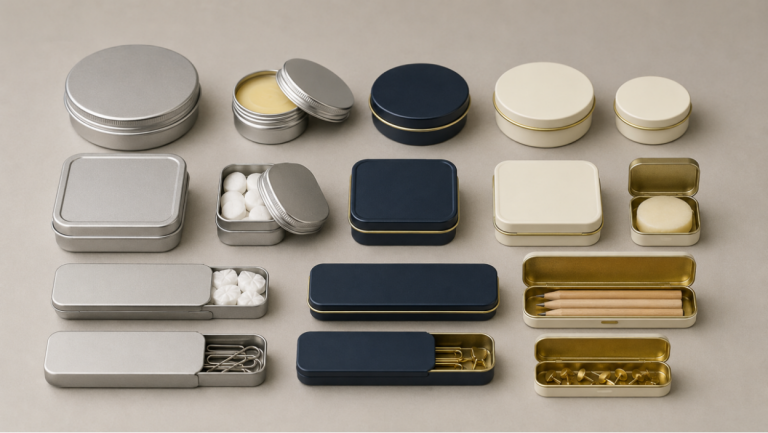
A screw-top lid supports deliberate closing and can suit products that benefit from repeated opening, but thread design, torque, liner, and product residue affect the experience. A slip lid offers a clean profile and quick access but needs an appropriate fit and opening force. A hinged lid keeps the cover attached and can support kits, while the hinge changes orientation and packing.
Compare options in the tin lid types guide [Internal Link]. Evaluate the selected closure with representative users, filled samples, repeated cycles, and the actual label or decoration.
| Closure | Useful when | Verify before approval |
| Screw top | Controlled repeated closing is important | Thread engagement, torque, liner, residue and fill clearance |
| Slip lid | Simple profile and quick access are priorities | Fit range, opening force, retention and transit movement |
| Hinged lid | The cover should remain attached | Hinge durability, opening angle, orientation and pack-out |
| Press or specialty lid | A distinctive interaction supports the product | User force, repeatability, child access and market needs |
Match the Tin System to the Product
Describe the product form, ingredients or materials, oils, solvents, aromas, powders, particles, temperature, filling method, storage time, and expected use. A tin suitable for a dry accessory is not automatically suitable for a cosmetic, food, candle, chemical, or high-moisture fill.
For intended food contact, the FDA food-contact overview explains that packaging components are evaluated for their intended use. The same principle applies operationally across markets: approve coatings, liners, adhesives, inserts, and conditions for the exact product and destination rather than relying on the nominal container size.
Design Decoration for a Small Curved Surface
A small tin has limited uninterrupted area. Choose a hierarchy that remains clear at actual size: brand, product name or variant, essential mark, and required copy. Avoid placing fine type on the thread, lid curl, seam, or tightly curved transition. A lid-focused design may photograph well, while side copy needs stronger contrast and shorter lines.
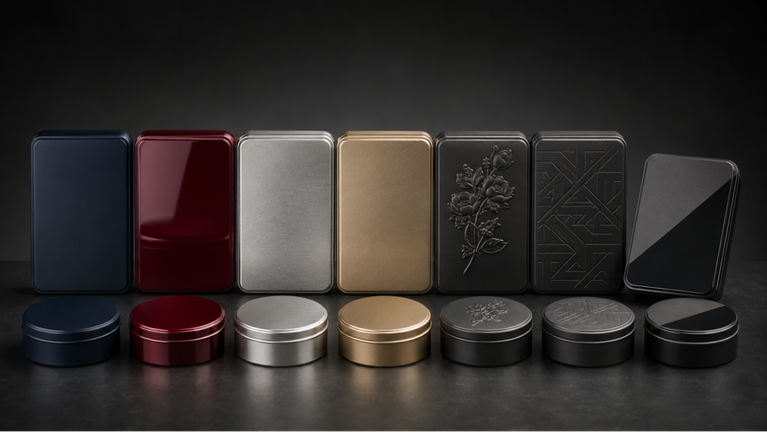
Use a physical print-size proof and a formed sample. The custom printed tins design guide [Internal Link] helps teams anticipate forming, registration, embossing, and edge constraints that a flat artwork view can hide.
Specify Liners, Inserts, and Secondary Components
A liner may support a seal, cushioning, compatibility, or user experience, but it also consumes space and changes closing behavior. An insert may organize a sample kit or protect a small item, while a shrink band, label, sleeve, or pouch may carry tamper, barrier, identity, or regulatory functions.
List each component and its role. Do not assume the lid alone creates a barrier or tamper-evident system. Identify which supplier provides each part, who validates the complete pack, and how the component is applied during filling or kitting.
Test the Filled Tin Through Its Real Use Cycle
A packaging sample should be filled, closed, labeled, packed, stored, handled, opened, and reclosed as intended. Observe lid movement, residue, leakage or dust escape, scuffing, denting, label lift, aroma transfer, user force, and product removal. The required tests depend on the actual product and route.
For screw closures, inspect the screw top tin range [Internal Link] as a structural starting point, then validate the chosen size and closure. For quick-opening formats, compare click-clack tins [Internal Link] only where the mechanism fits the product and user.
Plan Wholesale Packing and Count Control
Small tins can move and rub in bulk cartons. Define nesting or separation, orientation, units per inner pack, units per carton, carton weight, protection for decorated surfaces, and count verification. If lids and bodies are packed separately, document pairing, cleanliness, and assembly responsibility.
Track quantities by decoration and component version. A simple tin can become operationally complex when several lid colors, labels, liners, inserts, and product variants are combined. Keep one item code or controlled bill of materials for each approved finished pack.
2 oz Tin RFQ Checklist
Include the following with a wholesale quotation request:
- Meaning of 2 oz, product density or target fill, sample product, usable dimensions, headspace, and filled weight.
- Lid type, opening and closing behavior, liner or seal, repeated-use expectations, and user requirements.
- Product contact, coating, filling temperature, storage conditions, compatibility evidence, and destination markets.
- Decoration files, print method, finish, labels, sleeves, tamper components, and barcode or required-copy zones.
- Quantity by version, packing method, sample stages, acceptance criteria, destination, and required delivery date.
Frequently Asked Questions
Do all 2 oz tins hold the same amount?
No. Nominal capacity may refer to different measures or seller categories. Usable volume depends on internal geometry, lid displacement, liner, insert, headspace, product density, and target fill.
Are 2 oz screw top tins leakproof?
A screw closure alone does not prove leak resistance. Thread design, torque, liner or seal, product viscosity, temperature, residue, repeated use, and handling must be validated on the complete filled pack.
Can a 2 oz tin be used for food or cosmetics?
Possibly, but the exact tin, coating, liner, adhesive, printing, fill process, storage conditions, and market requirements must be approved for the intended product. Nominal size does not establish suitability.
What sample should a buyer request?
Request a dimensionally representative tin with the intended lid and components, then fill and test it with the actual product. A decorated formed sample and an agreed packed reference should follow when artwork and wholesale packing matter.
Conclusion
A useful 2 oz tin specification goes beyond a capacity label. Define the measure, verify usable geometry, choose the closure by behavior, approve every contact component, design for the small surface, and test the filled pack through storage, handling, and repeated use.
To review small-tin formats and a wholesale RFQ, contact ShingWah Tins [Internal Link] with the product sample, target fill, dimensions, closure preference, quantity, artwork status, destination markets, packing method, and required date.
Technical note: Nominal capacity, food or cosmetic contact, seal, leak, barrier, child-resistance, shelf-life, regulatory, and performance claims must be verified for the exact filled packaging system, intended use, user, test method, and target market.