

Tin Lid Types: How to Choose the Right Closure for Your Product
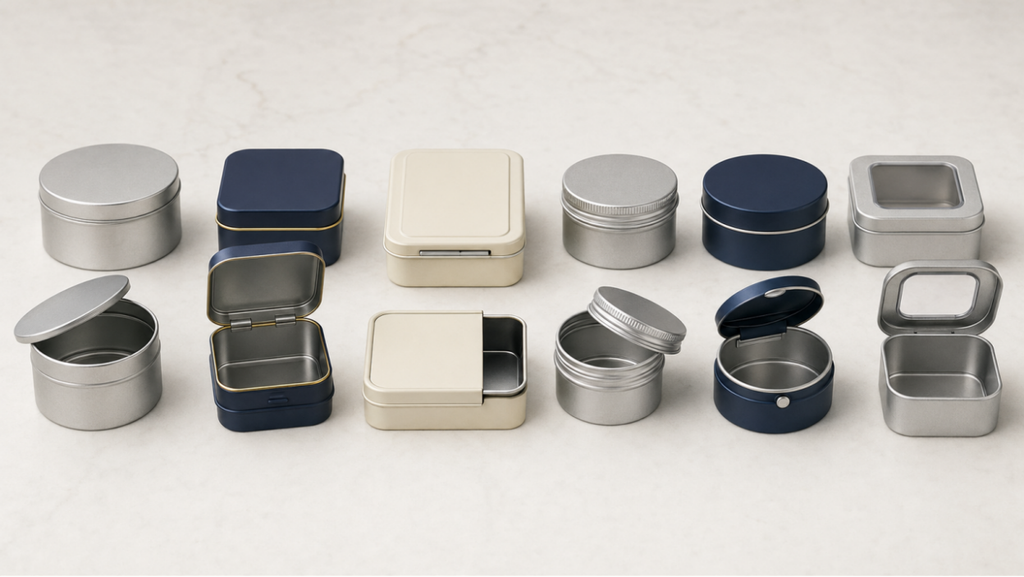
The lid is the part of a tin package customers handle most, yet it is often selected after shape and artwork. That order can create problems: opening force feels wrong, the lid separates during use, a hinge conflicts with shelf orientation, or a decorative closure is expected to provide a barrier it was not designed to deliver.
This guide compares the main tin lid types and connects each mechanism to product access, user experience, protection, decoration, and manufacturing. A closure should be approved with the filled pack and should never be described as airtight, child resistant, or tamper evident without the appropriate design and validation.
Slip Lids: Simple and Versatile
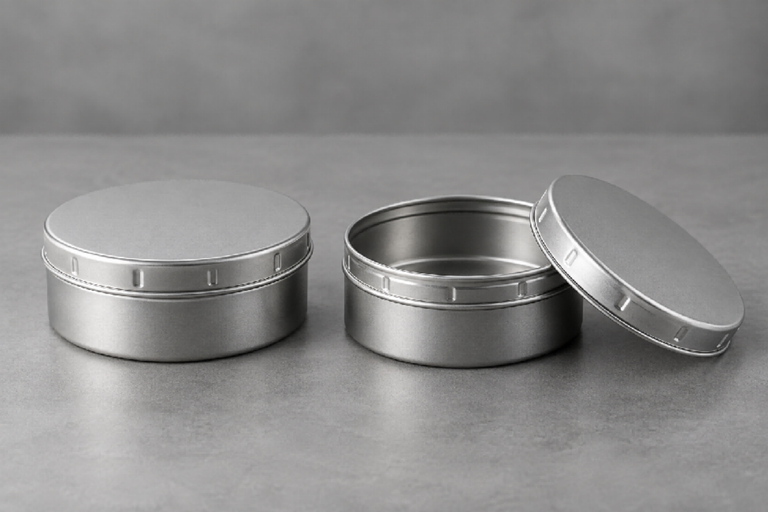
A slip lid fits over the base or body with friction. It creates a clean two-piece form, provides a large print area, and works across many round, square, and rectangular tins. The opening can feel calm and gift-like when tolerances are controlled.
The lid is separate after opening, which may be inconvenient for portable use. Fit can also change with coating, forming tolerance, temperature, and repeated handling. Browse slip lid tin containers [Internal Link] and test lid retention with the real product and shipping method.
Hinged Lids: Attached and Easy to Reopen
A hinged lid remains connected to the base, reducing the risk of loss and creating a book-like reveal. It suits kits, stationery, confectionery, gift sets, cards, and products opened frequently. Hinge position determines the front, artwork orientation, and display direction.
Check opening angle, hinge durability, finger clearance, and whether the lid remains stable when open. The hinged lid tin range [Internal Link] provides common structure options.
Slide Lids: Compact and Interactive
Slide lids are common on slim tins for mints, cards, stationery, and small accessories. The lid stays with the body and creates a tactile opening motion. Stop features and track friction must be controlled so the lid does not release accidentally or bind after decoration.
The sliding direction should support product access and artwork. Test pocket use, repeated cycles, debris sensitivity, and product pressure against the lid. Review slide lid tins [Internal Link] for available formats.
Screw Tops, Click-Clack Lids, and Windows
Explore screw top tins [Internal Link], click-clack tins [Internal Link], and window tin boxes [Internal Link] as starting points. For regulated applications, a product page or visual mechanism is not a substitute for current certification and market-specific compliance review.
| Closure | Primary strength | Key limitation to validate |
| Screw top | Controlled twist and strong repeated-use cue | Thread engagement, torque, liner, and product compatibility |
| Click-clack | Distinct tactile interaction and compact opening | User force, cycle life, and accidental activation |
| Window lid | Shows the product before opening | Window material, attachment, barrier, scratching, and light exposure |
| Child-resistant structure | Designed opening sequence for regulated uses | Formal testing, market rules, labeling, and production control |
Use a Closure Decision Checklist
The selected lid should be included in early fit and artwork samples. Changing the mechanism late can alter dimensions, tooling, dielines, insert design, and case packing.
- Define who opens the package, how often, and under what conditions.
- State whether the lid must remain attached or resist accidental opening.
- Identify the required moisture, oxygen, odor, leakage, tamper, or child-resistance function.
- Specify which component provides the barrier or evidence of opening.
- Test opening force, retention, alignment, cycle life, and filled-pack transit.
- Coordinate lid structure with artwork orientation, barcode placement, and retail display.
Frequently Asked Questions
Which tin lid is most airtight?
No decorative lid type should be assumed airtight by name. Barrier performance depends on the complete closure, liner or seal, tolerances, product, and validated test method.
Is a screw top always more secure than a slip lid?
A screw top provides threaded engagement, but suitability depends on torque, liner, product migration, accidental opening, user access, and the exact design. Test the filled pack.
When is a hinged lid best?
Use it when the lid should stay attached, the product is opened repeatedly, and a book-like reveal supports the use. Confirm hinge life and opening angle.
Conclusion
The right tin lid balances user access, product protection, repeated use, decoration, and production. Select the mechanism early, define the function precisely, and validate the filled pack instead of relying on closure names.
For lid samples and structure recommendations, contact ShingWah Tins [Internal Link] with the product, dimensions, quantity, required function, market, and target launch date.
Technical note: Product-contact, barrier, shelf-life, child-resistance, recyclability, regulatory, and performance claims must be verified for the exact packaging system and target market.

4 Comments