
Christmas Tin Canisters: How Santa-Inspired Packaging Becomes a Holiday Keepsake
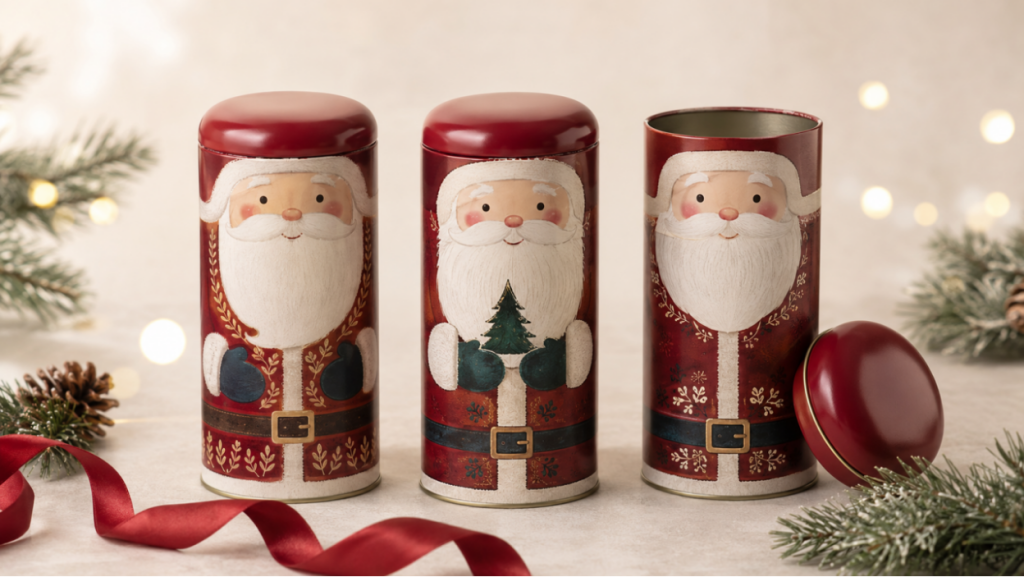
Christmas tin canisters can do more than carry seasonal treats. A tall character pack can turn the lid into Santa’s hat, the body into the costume, and the opening moment into part of the gift. The result is a shelf display, a present and a reusable keepsake in one format.
This is different from a conventional cookie-tin campaign. The commercial idea is not simply to print Christmas artwork on a round box. Structure, lid, character, contents and shipping all have to work together so the canister still feels premium after it has been opened.
For brands evaluating holiday gift tins, this guide focuses on character-led canisters. For a broader seasonal calendar, assortment and inventory framework, use the holiday tin packaging guide [Internal Link].
Why Character Canisters Win Holiday Attention
A character canister is understood from a distance. The upright silhouette creates a strong shelf block, while the face and costume communicate the occasion before a customer reads the product name. That makes Christmas tin canisters useful for confectionery, tea, cocoa, biscuits, ornaments, beauty minis and corporate gift kits.
The best decorated tins perform three jobs at once: they identify the season, raise perceived gift value and suggest a useful life after the original product is gone. A recognizable form can also support an annual collection, giving the brand a repeatable structure while artwork changes from year to year.
Novelty alone is not enough. A canister that rocks on the shelf, opens too tightly, interrupts the face at the lid seam or leaves the contents rattling will feel like a decoration rather than dependable packaging. The structural brief must come before the illustration.
Choose the Canister Architecture Before Drawing Santa
Start with the product volume, fill method, required opening and master-carton limits. Custom cylinder tin cans [Internal Link] provide the natural base for a tall character because the wraparound body creates a continuous costume panel. A rounded or pillow-style lid can become the hat without requiring the whole pack to be a complex novelty shape.
If the campaign needs a tree, ornament, house or proprietary silhouette, review unique shaped tin boxes [Internal Link] early. Unusual profiles can create stronger recognition, but they also affect inserts, filling, carton efficiency, dent protection and tooling decisions.
| Development route | Best use | Main trade-off |
| Decorated stock tin | Short tests, local activations or urgent seasonal replenishment | Fastest route, but structure, color and artwork freedom are limited |
| Custom print on an existing mold | Most branded Christmas tin canisters and repeat annual programs | Balances distinction, proven fit and development efficiency |
| New custom structure or tooling | A proprietary silhouette, character reveal or long-term collectible series | Highest differentiation, with more sampling, cost and lead-time exposure |
A hybrid route is often practical: keep a proven canister and lid across several campaigns, then update the print, belly band, tag or inner card. That protects product fit and packing performance while giving the holiday edition a new visual story.
Turn the Lid and Body Into One Character
Treat the closed pack and the opened pack as two compositions. On the closed canister, the hat, face, beard, belt and product message should read as one figure. After opening, the remaining body should still look intentional rather than like a character with a missing head.
Use the custom printed tins design guide [Internal Link] to set artwork safe areas, dielines and formed-sample checks. Character packs need extra attention around the lid curl, body seam, shoulder, base roll and any transition where the artwork must visually align.
- Keep eyes, small facial details and required legal copy away from the lid seam and tight radii.
- Create a clear front panel, but confirm the artwork also reads from a three-quarter retail view.
- Reserve a quieter side or back panel for ingredients, warnings, barcode and recycling guidance.
- Approve the character on a formed sample; a flat proof cannot show distortion, gloss changes or seam alignment.
One or two controlled effects usually outperform a crowded finish specification. Embossed belt details, metallic gold accents, matte red and selective gloss on the beard can create depth. The tin packaging finishes guide [Internal Link] explains how embossing, varnish and metallic show-through influence premium presentation.
Match the Tin to the Product, Not Only the Artwork
A Christmas tin canister is a rigid outer package, but product protection depends on the complete system. Confectionery may need a sealed inner bag and tray; tea and cocoa may need stronger aroma and moisture control; beauty sets or ornaments may need a fitted insert that prevents movement and presents the contents in a deliberate reveal.
Do not treat a removable lid as proof of a hermetic seal. Use the food-grade tin packaging guide [Internal Link] when evaluating coatings, liners, closures and inner barriers for edible products.
- Test real filled weight, headspace, opening force and product removal rather than approving an empty sample.
- Check whether the hat-shaped lid encourages consumers to lift, twist or pull in the intended direction.
- Validate the insert after vibration, drop and parcel-handling simulations appropriate to the sales channel.
- Confirm food-contact, labeling and market requirements for the exact tin, coating, inner pack and product.
Build a Gift and Reuse Story
The strongest holiday gift tins give customers a reason to keep them. A tall canister can store ornaments, craft supplies, tea bags, small toys or future gift items. Reuse instructions can appear on an insert or hangtag so the exterior remains visually clean.
For an annual collection, keep one recognizable design rule—such as silhouette, character scale or lid color—then vary illustration, year, finish or accessory. Vintage-inspired Christmas tins can feel collectible, but the brand name and product still need to be clear enough for first-time shoppers.
Reuse can extend the useful life of packaging, and metal may be recyclable where local systems accept it. Avoid unsupported environmental promises. Give customers accurate disposal guidance for the tin, plastic window, insert and inner pouch as separate components when their routes differ.
Plan the Seasonal Launch Backward
Character canisters add artwork-alignment and fit checks to an already short holiday window. Review the custom tin box manufacturing process [Internal Link] before committing to a launch date, then work backward from the required warehouse or retailer delivery date.
- Lock the product dimensions, fill count, inner pack and insert before final artwork.
- Confirm whether an existing mold meets the campaign objective before opening new tooling.
- Allow time for dielines, artwork review, color proofing, formed samples, production, inspection and freight.
- Approve the tin in both closed and open states, including barcode position and required copy.
- Check master-carton quantity, pallet pattern and e-commerce protection before mass production.
- Separate evergreen inventory from highly dated artwork and define a post-season plan.
A stock-tin promotion can be useful when speed and low campaign risk matter most. A custom printed program is better when the canister must carry a distinctive character, support an annual series or coordinate with a wider retail launch. The route should follow the commercial objective, not the other way around.
Design for Retail, E-commerce and Corporate Gifting
Retail packaging needs instant recognition and a stable shelf footprint. E-commerce needs protection against denting, scuffing and lid separation, plus a front that photographs well at thumbnail size. Corporate gifting may add name cards, sleeves or variable labels, so personalization should be planned without covering the character artwork.
If one Christmas tin must serve several channels, create a base specification that protects the product, then use channel-specific outer cartons, labels or inserts. This keeps the canister consistent while avoiding compromises in parcel protection or retail display.
Frequently Asked Questions
What can Christmas tin canisters hold?
Common applications include confectionery, biscuits, tea, cocoa, ornaments, beauty minis, stationery and promotional gift sets. Product fit, coating, inner packaging and inserts must be specified for the actual contents.
Do Christmas tins with lids keep food fresh?
The tin provides rigidity and handling protection, but freshness depends on the complete packaging system. Moisture- or oxygen-sensitive products often require a validated inner barrier.
Is a new mold necessary for a Santa tin?
Not always. A tall cylinder with a rounded lid can create a convincing Santa character through printing and finishing. New tooling is considered when a proprietary silhouette, special opening or unique product fit justifies it.
How early should brands order custom Christmas tins?
Work backward from the required delivery date and include product-fit samples, artwork approval, formed decoration samples, production, inspection and freight. New tooling and complex finishes require additional time.
Can the same canister support future holiday editions?
Yes. Keeping the structure and insert stable while refreshing artwork, finish, sleeve or card can reduce redevelopment risk and support a recognizable annual collection.
Conclusion
Christmas tin canisters work when character, structure and product protection are designed as one system. Start with a dependable canister, make the lid part of the reveal, approve artwork on formed metal, protect the real contents and plan production backward from the delivery date. The result can earn attention during the selling window and remain useful after the holiday is over.
To compare existing canister molds, decoration options, inserts and seasonal production routes, contact ShingWah Tins [Internal Link] with the product, dimensions, quantity, artwork stage, destination and required delivery date.