
Tin Storage Containers for Dry Foods Specification Guide
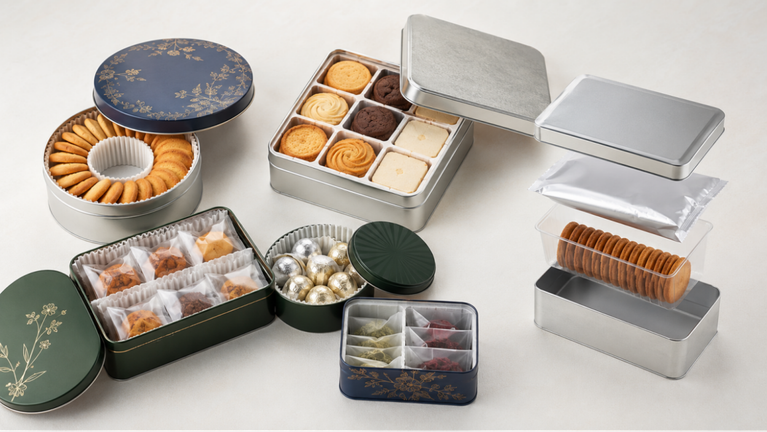
Tin storage containers can serve as retail packs, rigid outer containers around sealed pouches, refillable household storage, or gift tins kept after the original food is gone. Those uses look similar in a product photo but require different decisions about direct contact, closure, lining, labeling, cleaning, and validation.
This guide focuses on storage and refill programs for dry foods. The published food-grade tin packaging guide explains freshness and the broader packaging system. Here, the practical question is how to specify a tin that stacks, opens, refills, identifies contents, and remains appropriate for its stated use without overclaiming barrier or safety performance.
Define the Tin’s Role in the Food System
State whether the tin is the primary food-contact package, a secondary pack around a sealed pouch, or a reusable storage container supplied after purchase. Identify the food type, oil and moisture level, particle size, fill temperature, intended storage time, and target market. A decorative tin around an intact inner pouch has a different contact and barrier role from a directly filled container.
The phrase food grade is not a universal material name. Coatings, inks, adhesives, seals, liners, inserts, and cleaning conditions all belong to the intended-use assessment. Ask the responsible supplier and brand team to document which components may contact food and which authorization, specification, or test supports that use.
Choose Direct Fill or an Inner Barrier Deliberately
An inner pouch can provide the main moisture, aroma, grease, or oxygen barrier while the tin provides rigidity, decoration, organization, and reuse value. Direct fill may simplify the unboxing experience but places more responsibility on the interior coating, seams, closure, filling process, and cleanliness controls.
Do not assume the metal body alone determines shelf life. Build the decision around the actual food, target shelf life, storage conditions, and full package. Use product-specific stability or shelf-life work when making freshness claims.
Specify Lid Fit for Daily Handling
For a storage tin, users may open the lid far more often than they would open a one-time gift pack. Define the desired opening force, whether the lid stays attached, how it recloses, and whether it remains secure when carried or stacked. Test filled weight, coating, repeated use, and normal household handling.
A slip, plug, hinged, or screw closure can feel secure without being airtight or tamper evident. The tin lid types guide helps compare mechanisms, but the final choice should be approved with the production-intent body, lid, liner, decoration, and fill.
| Storage program | Tin’s main role | Priority checks |
| Sealed pouch inside tin | Rigid display and reusable outer pack | Pouch fit, lid clearance, labels, and reuse wording |
| Direct dry-food fill | Primary container | Contact components, cleanliness, closure, and shelf-life plan |
| Refillable household tin | Repeated dry storage | Opening cycles, cleaning instructions, coating durability, and relabeling |
| Assorted wrapped items | Organization and presentation | Cavity fit, count control, migration of odors, and item separation |
Engineer Stable Stacking and Shelf Use
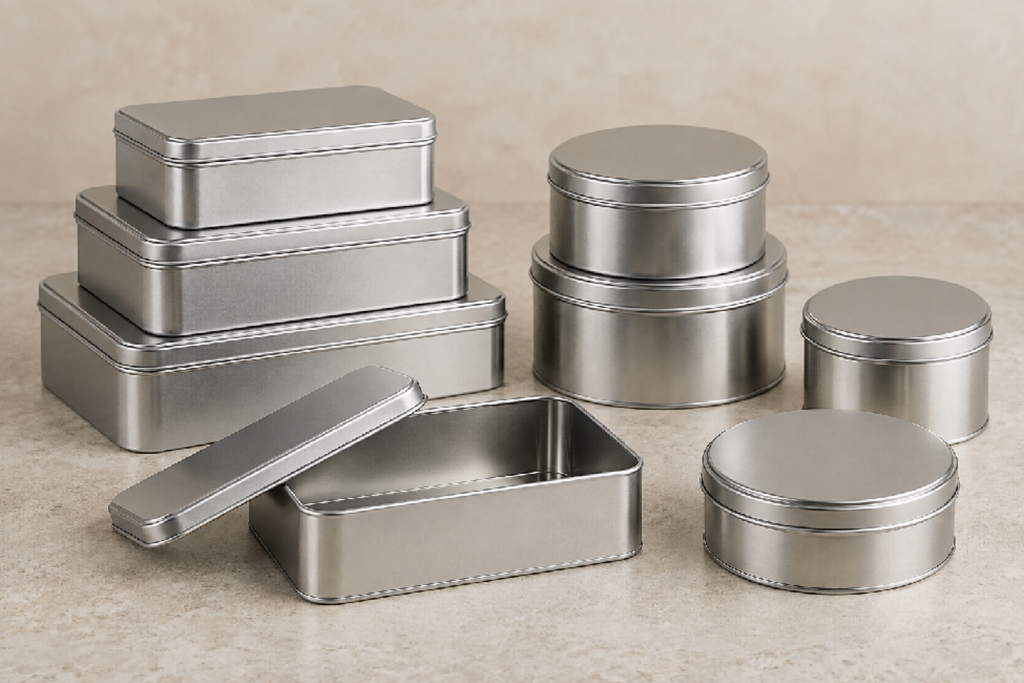
Stackability should be designed, not inferred from flat-looking lids. Check base-to-lid registration, lid projection, side-wall strength, filled weight, center of gravity, and how a stack behaves after repeated opening. A stable display stack may still need dividers or trays for transport.
Plan the household footprint as well as the shipping carton. Wide shallow tins make contents visible; taller tins use shelf area efficiently but may be harder to reach into. Rectangular formats can organize shelves, while round formats offer smooth handling. Choose the geometry around product access and storage, not only the front-view photograph.
Plan Refill Labels and Consumer Instructions
Reusable storage creates an information problem: once the original product is removed, the tin may no longer show the current contents, date, allergen context, or preparation instructions. Provide a removable label area, writable field, replaceable card, or other system that supports the intended refill behavior. Avoid implying that an old label remains accurate after the contents change.
If cleaning is expected, validate the method against the coating, seams, inks, adhesives, and any liner. Do not claim dishwasher-safe, corrosion-resistant, or suitable for indefinite reuse unless the final construction and instructions support those statements. A dry-wipe recommendation and a wash-and-sanitize process are not interchangeable.
Control Decoration for Repeated Handling
Storage tins receive more abrasion, hand contact, and lid movement than many display-only packs. Put essential identification where it remains visible in a stack and keep fine text away from formed edges. If a writable or removable label is planned, test adhesion and clean removal on the final coating. Follow the custom printed tins guide for dielines, color control, and production proofing.
Validate the Filled Storage System
Approve the complete system with the intended food or representative fill, inner pouch or liner, label, closure, and shipping case. Check lid operation, stacking, rattle, scuffing, odor transfer, cleanliness, and the condition after the planned number of opening cycles. Packaging tests should reflect the declared use rather than a generic empty-tin inspection.
Keep a controlled drawing, approved sample, component specification, and change record. The tin box manufacturing process can align sampling and production approvals, while the responsible food business confirms regulatory and product-performance evidence.
Tin Storage Container Request for Quotation Checklist
Include these items in one buyer brief:
- Food type, direct-contact or secondary role, fill conditions, inner pouch or liner, target market, and intended storage period.
- Usable internal dimensions, fill quantity, access opening, preferred shape, lid behavior, and expected opening cycles.
- Stacking height, filled weight, shelf footprint, label or refill-identification system, and consumer instructions.
- Interior and exterior coating requirements, decoration, abrasion expectations, cleaning statement, and evidence requested.
- Quantity, sample stages, approval tests, case pack, pallet limits, ship-to location, and launch date.
Frequently Asked Questions
Can any coated tin be used in direct contact with food?
No. The complete intended use, including food type, conditions, coating, inks, seams, and other components, must match the applicable specifications and evidence for the target market.
Does a friction-fit lid make a storage tin airtight?
No. A lid can feel snug without providing a validated moisture, oxygen, aroma, or leak barrier. Test the complete package before making barrier or shelf-life claims.
Can consumers wash and reuse a food tin?
Only make a specific cleaning or reuse statement after checking the final coating, seams, decoration, liner, and instructions under the intended conditions. Otherwise, keep the claim limited and clear.
Are tin storage containers suitable for tea or coffee?
They can be part of a suitable system, often with an inner barrier, but product protection depends on the complete pack and the required shelf life. Confirm the actual product and storage conditions.
Conclusion
A successful storage tin is defined by its role, not by a generic food-safe label. Specify contact responsibility, inner barrier, lid behavior, stackability, refill identification, cleaning statement, and filled-pack validation before committing to production.
For a production brief and sample discussion, contact ShingWah Tins with the food type, pack role, dimensions, fill quantity, target market, quantity, reuse intent, and evidence required for the final program.
Technical note: This article is packaging procurement information, not food-safety or legal advice. Confirm the final materials, intended conditions of use, cleaning instructions, labeling, and market-specific requirements with qualified specialists.