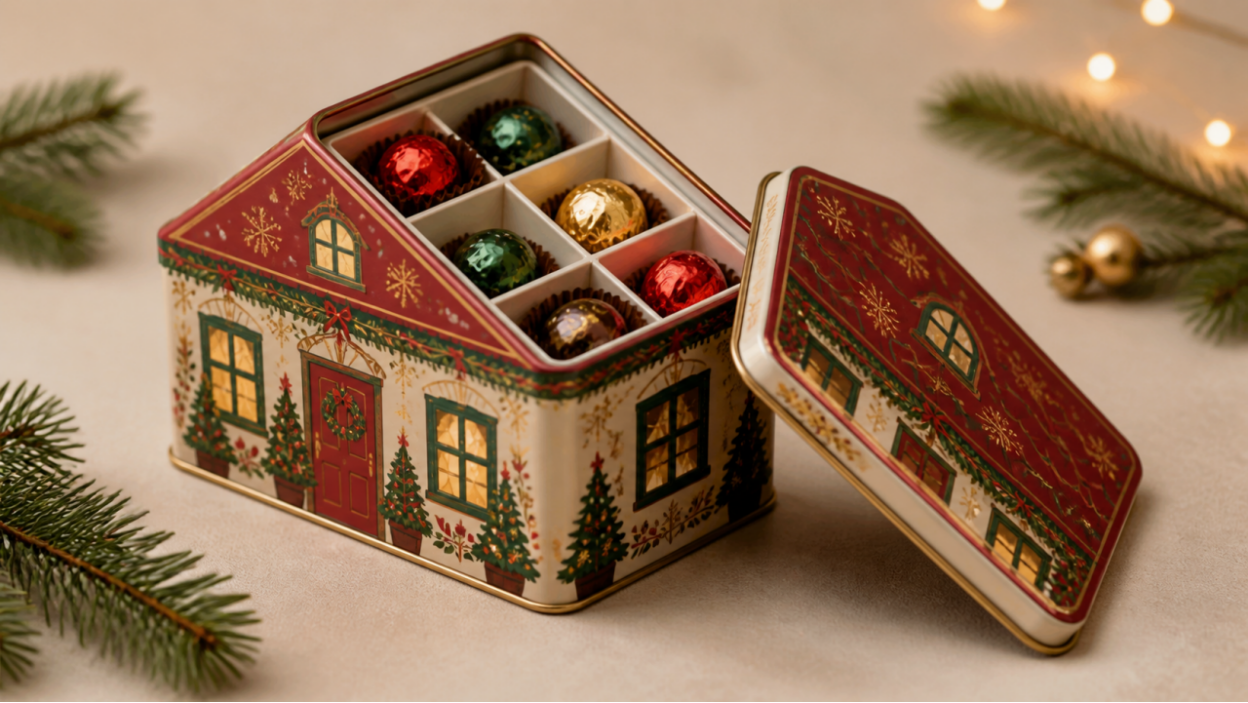
Christmas House Tins: A Structural Guide for Gift Brands

Christmas house tins turn the package itself into part of the seasonal scene. The silhouette can suggest a cottage, bakery, workshop, or winter storefront before a shopper reads the product name. For confectionery and gift brands, that gives the pack strong display value, but it also creates structural questions that do not appear on a standard flat tin: where the lid separates, how the roof affects stacking, how the insert fits, and whether the artwork still aligns after forming.
This guide focuses on those house-specific decisions. It is not another general Christmas cookie-tin calendar or character-canister concept. The aim is to help a buyer define a manufacturable Christmas tin box whose structure, opening, artwork, contents, and shipping carton support one clear gift experience.
Define What Makes the Tin Read as a House
A house effect can come from graphics, surface relief, or the outer profile. These routes do not carry the same tooling, filling, or packing implications. Begin by deciding whether the campaign needs a recognizable house from across the aisle or simply a familiar tin gift box with architectural artwork.
Review unique shaped tin boxes [Internal Link] before committing to a new profile. An existing structure may already provide the roof line, gable, or deep-lid proportion needed for the concept.
| House-tin route | How the house effect is created | Best use and main check |
| Printed standard tin | A square or rectangular body uses windows, doors, roof graphics, and a strong front elevation. | Efficient seasonal editions using an existing mold; confirm the art reads as a house without a custom silhouette. |
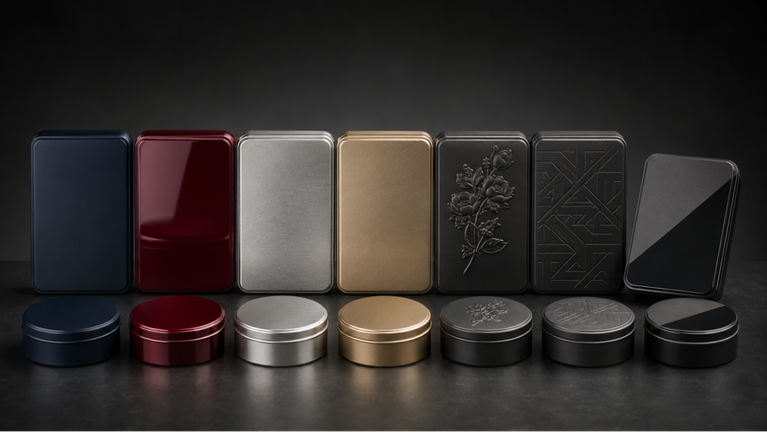
| Embossed architectural tin | Stamped windows, brickwork, roof tiles, or a centered door add shallow physical depth. | Premium gift programs that need tactility; keep relief away from seams, curls, and required copy. |
| Custom roof-profile tin | The formed outline includes a gable, pitched roof, or proprietary building shape. | Collector-led programs; confirm tooling, lid engagement, insert geometry, carton efficiency, and sampling time. |
Start With the Product Cube and Opening Direction
Do not choose the outside dimensions from an illustration. Measure the real product arrangement first, including individual wrapping, tray walls, paperboard thickness, finger access, and the clearance needed for a lid to engage. A tall gable can add exterior volume without adding useful internal space, so quote requests should state usable dimensions rather than only the maximum outside height.
Opening direction controls the reveal. A roof that lifts away may create theater but needs a secure fit during distribution. A deep lid over a shallow base can present the assortment on opening, while a side hinge can keep the house facade visible. Compare the underlying trade-offs in the guide to round, square, and rectangular tins [Internal Link] before adding novelty features.
- Record product length, width, height, count, weight, and intended orientation.
- Define the usable cavity after lid engagement, curls, seams, beads, and insert allowance.
- Choose whether the customer lifts, pulls, or hinges the lid and which face should remain visible.
- Test finger access and product removal with the filled pack, not an empty metal sample.
Map Artwork Across Roof, Walls, and Seams
Treat the closed pack as a small building with a front, roof, sides, and back. The front elevation should carry the fastest recognition cue. Roof panels can hold pattern or a secondary scene; side walls can continue the story; the back should reserve a calm area for product, barcode, and market copy. Keep doors, windows, faces, and fine borders away from curls, hinge hardware, lid seams, and tight formed radii.
The custom printed tins design guide [Internal Link] explains why a flat dieline cannot predict every change on formed metal. For a house tin, approve the artwork in the closed position, then remove the lid and confirm that the remaining walls still look intentional. If two panels must meet at an edge, use tolerant graphic transitions instead of lines that require perfect visual registration.
Design the Insert and Reveal as One Interior
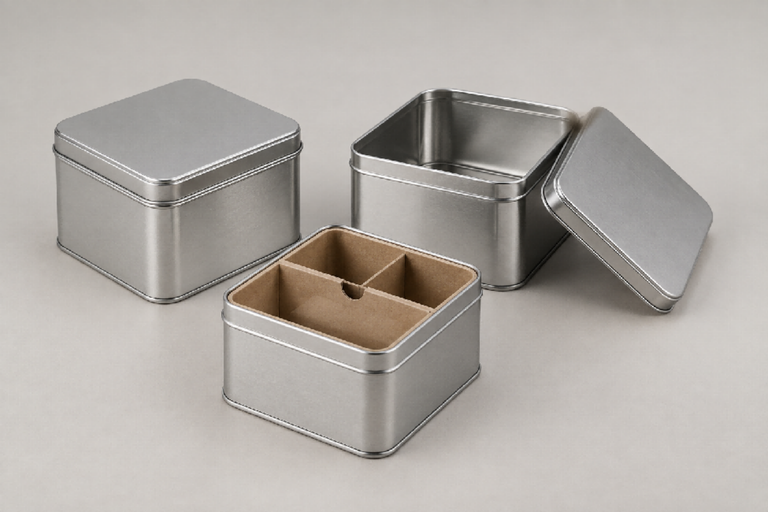
A house-shaped exterior can hide an awkward cavity if the insert is treated as an afterthought. Compartments should follow the product, not imitate every roof angle. A rectangular removable tray inside a shaped shell is often easier to load and may provide better product access. Paperboard, molded pulp, or another suitable insert can organize wrapped chocolates, tea sachets, ornaments, beauty minis, or small gift items while keeping the opening tidy.
For edible contents, define which layer provides hygiene, tamper evidence, aroma, moisture, and shelf-life performance. A decorative removable lid should not be assumed to provide a validated barrier. Use the food-grade tin packaging guide [Internal Link] when preparing the coating, inner-pack, and product-contact portion of the specification.
Plan Retail Display, Cartons, and E-commerce Protection
The same roof line that wins attention can create empty space in a master carton. Model the packed orientation early. Some house tins can nest in alternating directions; others need paperboard dividers, corner protection, or a retail tray that prevents the facade from rotating. Ask for the carton quantity, packed weight, and pallet pattern before approving final dimensions.
For e-commerce, protect the lid from separating and the roof edges from denting without hiding the package in unnecessary layers. Photograph the closed house, the opening action, and the interior reveal so the online listing explains why the structure is different. For retail, test the viewing angle at shelf height and make sure the price label or security tag does not cover the door or main brand panel.
Choose Existing Tooling or a New House Profile
An existing mold is the lower-risk starting point when the product fits, the lid action supports the reveal, and artwork can create enough architectural character. New tooling is justified when the roof profile is central to the campaign, the intended product cannot fit safely in available structures, or a repeat collectible series supports the additional development.
Review the custom tin box manufacturing process [Internal Link] before locking the launch. A shape-led tin adds decisions around drawings, tooling, blank development, forming trials, lid fit, inserts, decorated samples, inspection, and freight. Set a clear fallback date at which the project can move to a printed or embossed existing mold if the custom profile is not ready.
Christmas House Tin Specification Checklist
A focused brief helps a manufacturer compare existing molds with a new structure and quote the same scope that the brand expects. Include the following information:
- Packed product, count, unit dimensions, total filled weight, and whether each item has an inner wrap.
- Required usable internal dimensions, insert material, compartment layout, and removal access.
- Preferred house route: printed standard tin, embossed architectural tin, or custom roof profile.
- Opening direction, lid retention target, display face, stacking expectation, and retail orientation.
- Artwork stage, safe areas, decoration and finish preferences, barcode, and required copy zones.
- Order quantity, destination, required delivery date, sales channels, master-carton limits, and sample approvals.
Frequently Asked Questions
Are Christmas house tins only for cookies?
No. They can hold wrapped confectionery, tea, cocoa portions, ornaments, beauty minis, stationery, toys, or mixed gift sets. Product fit, inner packaging, coating, and inserts must be specified for the actual contents.
Does a house-shaped tin always require a new mold?
No. Architectural printing or embossing on an existing square or rectangular tin can create a convincing house. New tooling is considered when the external roof profile or a proprietary opening is essential.
Can a roof-profile tin be stacked?
Some designs can be stacked in a controlled tray or carton, while others need alternating orientation or dividers. Confirm filled-pack stability and carton loading with the exact structure.
Can the same house tin support future Christmas editions?
Yes. Keeping the structure and insert stable while changing artwork, finish, cards, or assortment can reduce product-fit risk and create a recognizable annual series.
Conclusion
Christmas house tins work best when the building idea is resolved as packaging, not only as illustration. Decide how the house effect is created, protect usable internal space, map every panel, design a practical reveal, and model the filled carton before approving the outline.
To compare existing house-style molds, embossing routes, inserts, and custom profiles, contact ShingWah Tins [Internal Link] with the product dimensions, count, quantity, artwork stage, destination, and required delivery date.
Technical note: Product-contact, barrier, shelf-life, child-resistance, recyclability, regulatory, and performance claims must be verified for the exact packaging system and target market.